Article
What Is Wirepas?

If you work in asset tracking or industrial IoT long enough, you'll eventually run into Wirepas. It shows up in smart lighting, smart buildings, smart meters, and industry 4.0 systems. And yet outside that world, almost nobody has heard of it. Ask a room full of software engineers about Bluetooth Mesh or Lora and you'll get nods. Ask about Wirepas and you'll mostly get blank stares.
That's a shame, because the underlying idea is genuinely clever, and it's the reason a battery-powered tag can sit on a piece of equipment for years, in a warehouse, hospital, mine, or a rail yard, and still report its location every day without anyone touching it.
This is a primer on what Wirepas is, how it works under the hood, and why we built Velavu on top of it.
The short version
Wirepas Mesh is a decentralized wireless networking protocol, originally developed out of research at Tampere University of Technology in Finland, now sold as a licensed firmware by Wirepas Ltd. "Decentralized" is the load-bearing word here. There's no central controller telling devices what to do. Every node in the network, whether it's a sensor, a tag, or a fixed anchor, carries enough intelligence to make its own networking decisions: which neighbor to route through, what transmit power to use, which radio channel is currently clean. Nodes cooperate with their neighbors rather than reporting up to anything.
The protocol itself is also hardware-independent. It's firmware that runs on standard, off-the-shelf 2.4 GHz radio chips (mostly Nordic Semi and Silicon Labs), the same ones used for Bluetooth Low Energy. Wirepas isn't a chip or a piece of hardware; it's software that turns commodity BLE-capable radios into nodes in a self-organizing mesh.
Put those two things together, decentralized logic plus hardware independence, and you get a network that can scale into the tens of thousands of devices without needing a network engineer to plan it out in advance.
How a Wirepas network forms
Here's the part that's easy to gloss over, and the part that explains most of what makes Wirepas useful: there's no master plan. Every device figures out its own place in the network by talking to its neighbors, using something close to a cost-based routing algorithm.
When a new node powers on, it goes through three steps:
Scan. It listens for beacon messages from nearby routers. Those beacons carry a cumulative route cost (roughly, how expensive it is to reach the gateway through that router), plus timing and frequency information.
Select. The node compares the routers it can hear and picks the cheapest path, factoring in link quality, how congested that router currently is, and a small fixed cost added per hop. It also keeps a second-best option in reserve.
Connect. It joins that router's cluster using the timing and frequency info from the beacon. If the new node has spare capacity, it starts advertising its own beacon so other nodes can route through it.
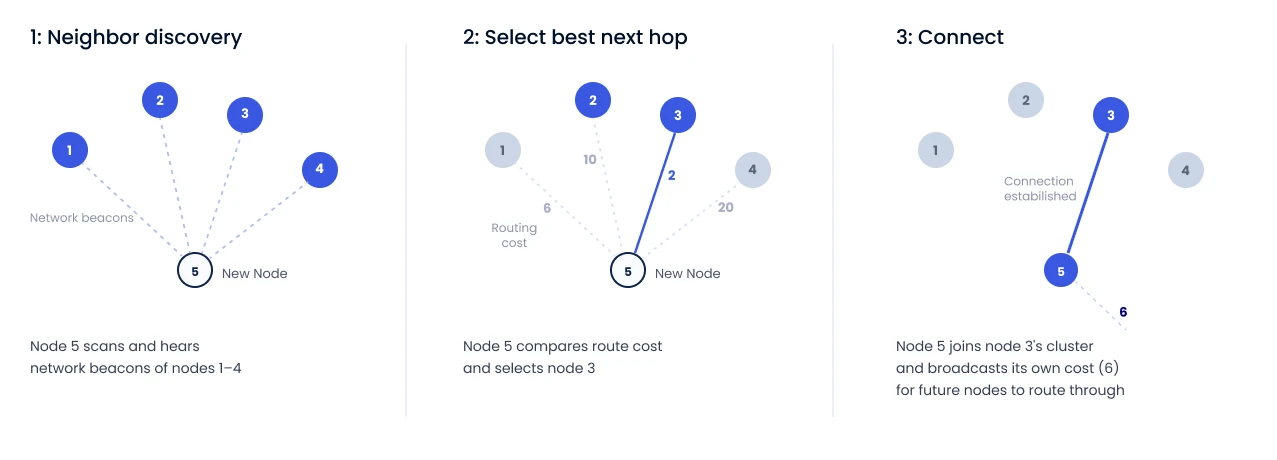
No node ever needs a global view of the network. It just needs to hear one other node. That's also what makes the self-healing behavior work: if a router drops offline, its neighbors don't wait for an all-clear from anywhere. They fall back to an already-known alternate route, or use neighbor information they've already gathered to pick a new next hop, without redoing a full scan.
Under the hood, Wirepas splits time and frequency locally so devices aren't stepping on each other. In Low Energy mode, the mode built for battery-powered devices, each router divides its own local cluster into scheduled timeslots (TDMA) across its chosen channel (FDMA), so member devices know exactly when to wake up, transmit, and go back to sleep. Devices aren't listening idly, which is most of why a Wirepas router can run for years on a coin cell or a small battery pack. There's also a Low Latency mode, using continuous CSMA-CA channel access, for cases like lighting control where speed matters more than battery life. Both modes share the same beacon signaling, so they interoperate on the same network.
Of the 40 channels available in the 2.4 GHz band, one is reserved for network discovery and the other 39 are fair game, with each router picking its own cleanest channel for its local cluster. If a channel gets noisy, say a nearby Wi-Fi access point starts hammering it, nodes just shift to a different one automatically. No one has to plan around it.
How this makes Wirepas different from BLE Mesh
None of this is abstract engineering trivia. It's the reason Wirepas behaves so differently from other mesh protocols in practice, particularly BLE Mesh, which is the comparison people reach for most often.
BLE Mesh doesn't route. It floods. A repeater device just rebroadcasts anything it hears, on the theory that if enough devices repeat a message enough times, it'll eventually reach a gateway. That works fine for a lighting install with a hundred switches. It falls apart as device count climbs, because repeaters aren't synchronized with each other. They step on each other's transmissions. Wirepas's own comparison materials describe a network of 1,000 repeaters turning a single sensor's message into roughly 1,000 rebroadcasts; scale that to 100 sensors reporting continuously and you're looking at well over 100,000 repeat transmissions for one round of updates. And because repeaters have to stay in continuous receive mode to catch traffic, they generally need to be mains-powered, which means real infrastructure and real installation cost.
Wirepas takes the opposite approach. Because every device actually routes, using the cost-based scheme described above, adding devices adds coverage instead of adding noise. Because gateways are just bridges with no special management role, you can add more of them to add capacity or resilience, and the network rebalances around them on its own. There's no environment planning step, no site survey to figure out where repeaters go. A device just needs to hear one other device.
The tradeoff worth being honest about: this only pays off past a certain scale and density. If you're wiring up thirty light switches in one building, BLE Mesh's simplicity is a real advantage and Wirepas is overkill. Wirepas earns its complexity when you're deploying hundreds or thousands of battery-powered devices across an area too large or too awkward to wire.
Why Velavu builds on Wirepas
We didn't set out to become a Wirepas company specifically. We set out to solve a narrower problem: tracking assets in places GPS doesn't reach. Warehouses, mines, rail yards, hospital basements. GPS needs a clear view of the sky, and most of the places our customers actually operate don't have one.
Wirepas turned out to be the best available answer for the parts of that problem that are hardest to solve any other way, mainly because of two things that fall directly out of the architecture above.
The infrastructure itself is fully battery-powered. Because routing doesn't require continuous listening the way flooding does, both our anchors and our tags can run on batteries for years, not days. Our Dorado anchors, built for harsh industrial sites, run for roughly 15 years on a single battery. That matters for deployment cost: no electrician, no cable runs, no waiting on a facilities team to approve conduit work. At NORCAT, a training mine in Ontario, our team deployed a full site with two installers in about two and a half hours. That timeline is only possible because there's no wiring involved anywhere.
It also holds up at scale, not just on day one. Our largest deployments run into the thousands of devices, including a rollout across roughly 18 Hyatt properties for staff panic-button tracking. A flooding-based mesh would choke well before that point. A routed one, with automatic rerouting and no single point of failure at any gateway, keeps working the same way at 10,000 devices as it does at 100.
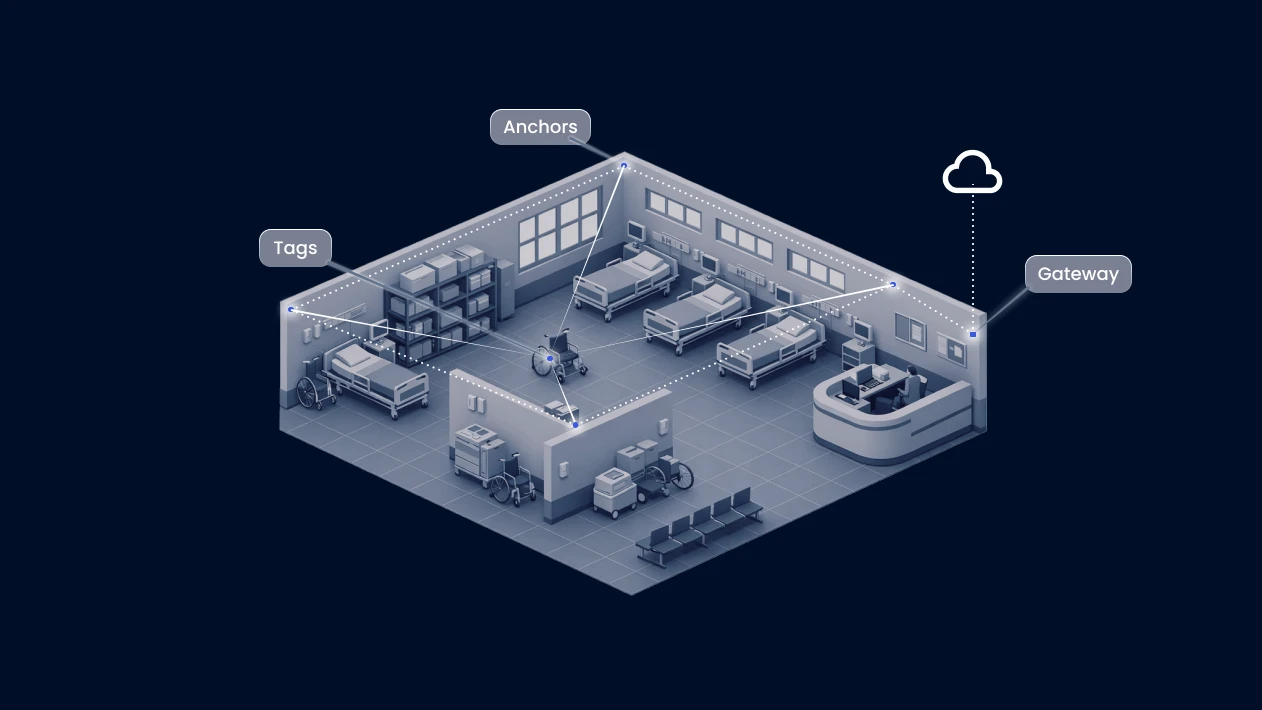
On top of Wirepas Mesh, we combine signal strength readings from each tag to multiple nearby anchors, and use trilateration to compute location in our cloud platform. Accuracy depends on how densely you place anchors: roughly 5 to 7 meters with anchors spaced 15 to 20 meters apart, tightening to 3 to 5 meters with denser placement. For most of what our customers track, tools, equipment, vehicles, people, that's more than enough resolution. It gets you room-level or zone-level answers to "where is it," which is usually the actual question being asked.
Where Wirepas isn't the right tool
Because Wirepas doesn't support round-trip-time or channel-sounding-based ranging today, it tops out at that few-meters accuracy, not sub-meter. If you need to know which shelf a pallet is on rather than which aisle, or you're tracking tens of thousands of tags in a single dense warehouse, a technology like Bluetooth Angle of Arrival is a better fit, even though it requires powered locators and costs more to install per square foot. We support that too, through a partnership with CoreHW, precisely because Wirepas mesh isn't the right answer to every tracking problem. And if a site already has dense Wi-Fi access point coverage, as many airports and retail spaces do, positioning off existing Wi-Fi infrastructure can mean not adding new hardware at all.
Wirepas Mesh | BLE Beacon | WiFi Location | Angle of Arrival | |
|---|---|---|---|---|
Typical use cases | Construction, mining | Fleets & cargo, event management | Airports, healthcare | Manufacturing, warehousing |
Positioning method | Mesh trilateration | BLE beacon scan | WiFi access point scan | Bluetooth angle of arrival |
Positioning accuracy | 3–5m | 3–10m | 5–15m | 0.5–2m |
Installation complexity | Low | Low | Low | Higher |
Tag cost | $15–$30 | $5–$10 | $35–$50 | $5–$10 |
We'd rather point a customer toward the technology that actually fits their site than force everything through one architecture because it's the one we know best. Most of the time, for the environments we specialize in, that's Wirepas. Not always.
FAQ
Is Wirepas the same as Bluetooth? No. Wirepas Mesh runs on the same 2.4 GHz radio chips as Bluetooth Low Energy, but it's a different protocol with its own routing and channel access logic. A Wirepas device won't show up in a phone's Bluetooth settings the way a BLE beacon would.
Is Wirepas open source? No. Wirepas Mesh is licensed firmware sold by Wirepas Ltd, not an open protocol like Zigbee or Thread. Hardware makers and platform providers license it to run on their own radio hardware.
What happens if a router goes offline? Its neighbors don't wait for anything. They fall back to an already-known alternate route or pick a new next hop from information they've already gathered, so the network keeps functioning without a full rescan.
Does Velavu only use Wirepas? No. Wirepas Mesh covers most of the sites we deploy, but we also support Bluetooth Angle of Arrival through a partnership with CoreHW for higher-accuracy needs, and can position off existing Wi-Fi infrastructure where it's already dense enough.
Where to go from here
If you want to see the mesh in action rather than read about it, our evaluation kit comes with a gateway, ten anchors, and ten tags, enough to build a real Wirepas network on your own site and watch the self-forming, self-healing behavior firsthand. Our hardware catalog covers the anchors and tags we've built specifically for harsh industrial environments, and the platform overview covers what the software does with the location data once the network is reporting it.