Case study
Underground Asset Tracking at NORCAT: A Wirepas Mesh Case Study
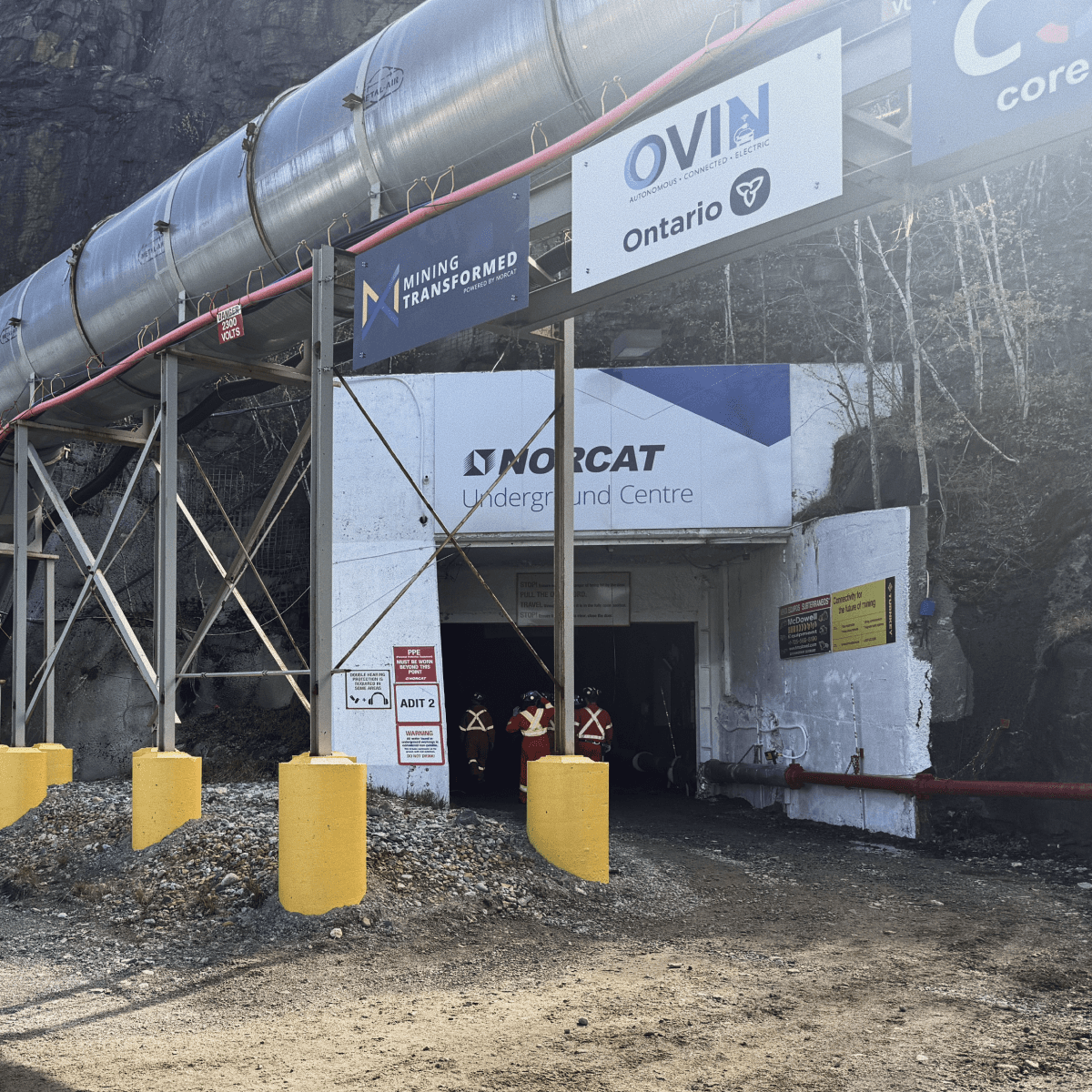
Underground mines are one of the few environments where GPS simply will not work. No satellite signal reaches a drift buried under rock, and running wiring to every corner of a working mine is expensive, slow, and has to be updated every time the mine expands. Most tracking technologies assume at least one of those two things is available. Underground, neither is.
That gap is why Velavu partnered with the NORCAT Underground Centre in Levack, Ontario, just outside Sudbury, a real mine used specifically for testing new technology. Over a project supported by the Ontario Centre of Innovation's Development & Commercialization Program, we deployed a full Wirepas Mesh network through NORCAT's drifts, tracked mining equipment and personnel across it for 8 months, and used what we learned to improve our commercial asset tracking system for underground mines.
The problem: tracking equipment where nothing else works
Ask anyone who runs an underground mine what eats their time, and "finding equipment" comes up fast. Scoops, scissor decks, personnel carriers, and haul trucks move constantly through a maze of drifts, and a shift boss with no tracking system spends a lot of time on their radio asking where equipment was last parked. Wired systems can technically do the job, but wiring an active mine is disruptive, expensive to extend, and has to survive blasting, moisture, and being damaged by vehicles travelling through the mine.
We wanted to know if Velavu's fully wireless, battery-powered Wirepas Mesh network could hold up in that environment and provide accurate enough tracking to be useful. NORCAT gave us a real mine to find out in, rather than guessing from a lab.
Why Wirepas Mesh is a good fit for underground mining
Before getting into what we tested, it's worth explaining why we picked Wirepas as the underlying protocol:
It's a fully routed mesh, not a flooding one. Some mesh protocols, including standard Bluetooth Mesh, work by flooding: every device rebroadcasts every message to every neighbor. That's simple to implement, but it falls apart once you get past a couple hundred nodes, because the network gets swamped with redundant traffic. Wirepas takes a different approach. Every device maintains its own routing table and only forwards data along a known path back to the gateway. That's what lets a Wirepas network scale to thousands of devices without collapsing, and it's also what makes it self-healing: if one anchor goes offline, the mesh automatically reroutes around it.
Every device is battery-powered, including the anchors. In most wireless systems, "wireless" only describes the tags. The fixed infrastructure, access points, repeaters, gateways, still needs power and often ethernet. Wirepas anchors don't. They run on the same time-slotted radio access that lets tags sleep between updates, which means an anchor can go 5 to 15 years on a single battery depending on the hardware. In an underground drift, that's the difference between a two-hour install and a multi-week electrical job.
It routes around rock, not through it. Underground radio propagation is difficult. Wireless radio waves can't go through rock, so they need to go around corners, through tunnels, and past parked equipment. Because Wirepas is a true mesh rather than a point-to-point link, a tag doesn't need a clean line of sight to the gateway. It just needs a path through its neighbors, and the network works out that path on its own.
Battery-powered mesh has its limits, and that shaped how we use it. Wirepas isn't magic. Every hop between the gateway and a device adds latency, and a mine drift is a long, narrow, mostly linear space, which means devices at the far end of a drift can end up many hops from the gateway. That's a real trade-off, and it's exactly what our NORCAT testing surfaced. More on that below.
For underground mining specifically, the combination of no infrastructure requirement, long battery life, and self-healing multi-hop routing is hard to match with any other wireless technology. WiFi and cellular need powered access points roughly every 50 to 100 meters. UWB delivers excellent accuracy but at a much higher infrastructure cost per square meter. Wirepas Mesh trades some of that accuracy for a network that a two-person team can deploy in an afternoon with no dependency on existing infrastructure.
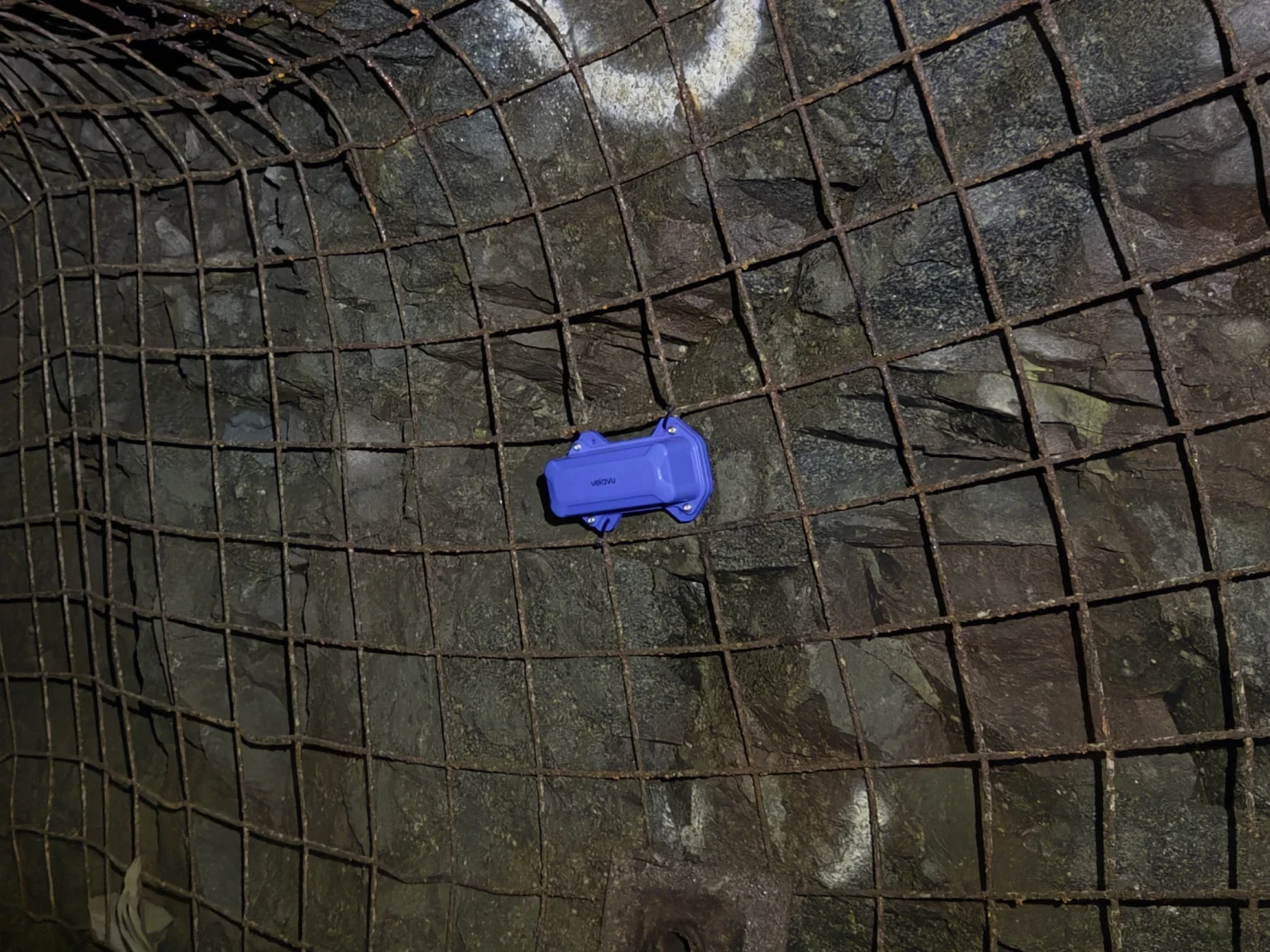
A Dorado anchor mounted on a drift wall. No power run, no ethernet, just a cable tie.
Deploying the network
Testing ran over three days on-site at NORCAT, with additional monitoring for months afterward. The scope was straightforward on paper: figure out how far apart anchors could be spaced, where on the drift wall they should be mounted, how the network held up over time, and whether the devices themselves could survive the environment.
In practice, that meant a two-person Velavu team walking sections of drift with anchors and a laptop, testing configurations, and adjusting as they went. We tried anchors at different spacings, in straight sections and around corners, and logged signal strength and routing behavior at each position. The whole system, gateway included, ran on a single ethernet connection from the mine's substation, so there was no dependency on the mine having its own network infrastructure.
Pavo HD tags went on mine equipment, scoops, scissor decks, a forklift, and personnel carriers among them, using magnetic and cable-tie mounts, the same mounting hardware we'd use on a rail car or a warehouse pallet jack. No custom brackets or hardwiring into the vehicles.
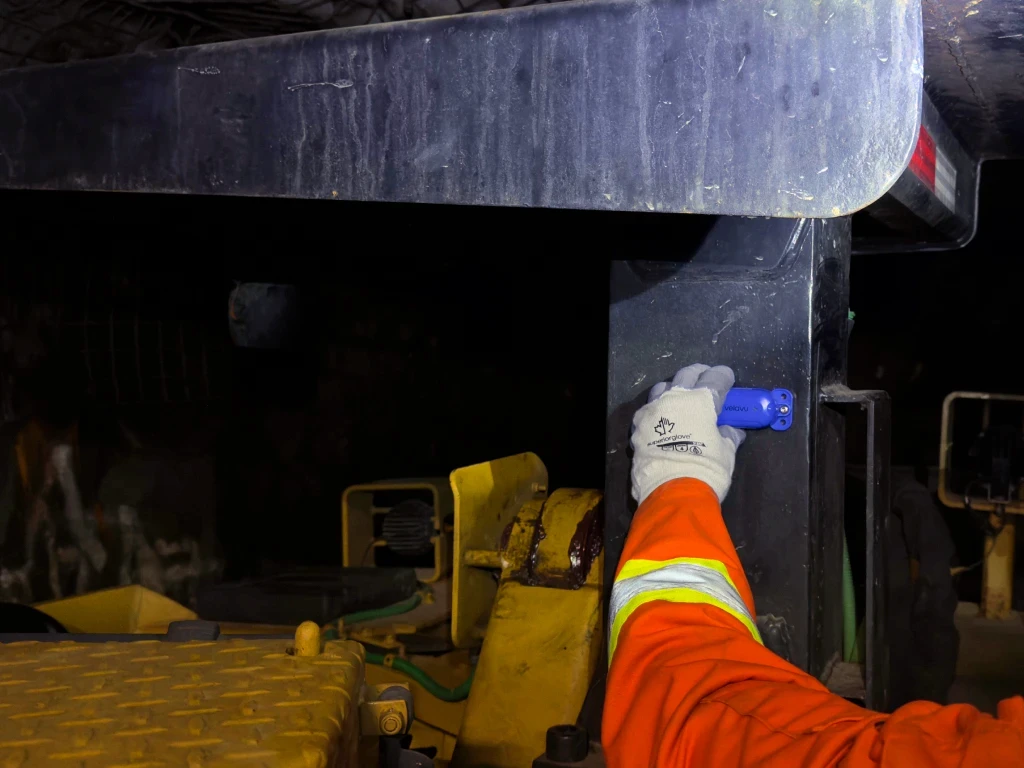
A Pavo HD tag magnetically mounted to a scoop vehicle. Mounting took minutes, not hours.
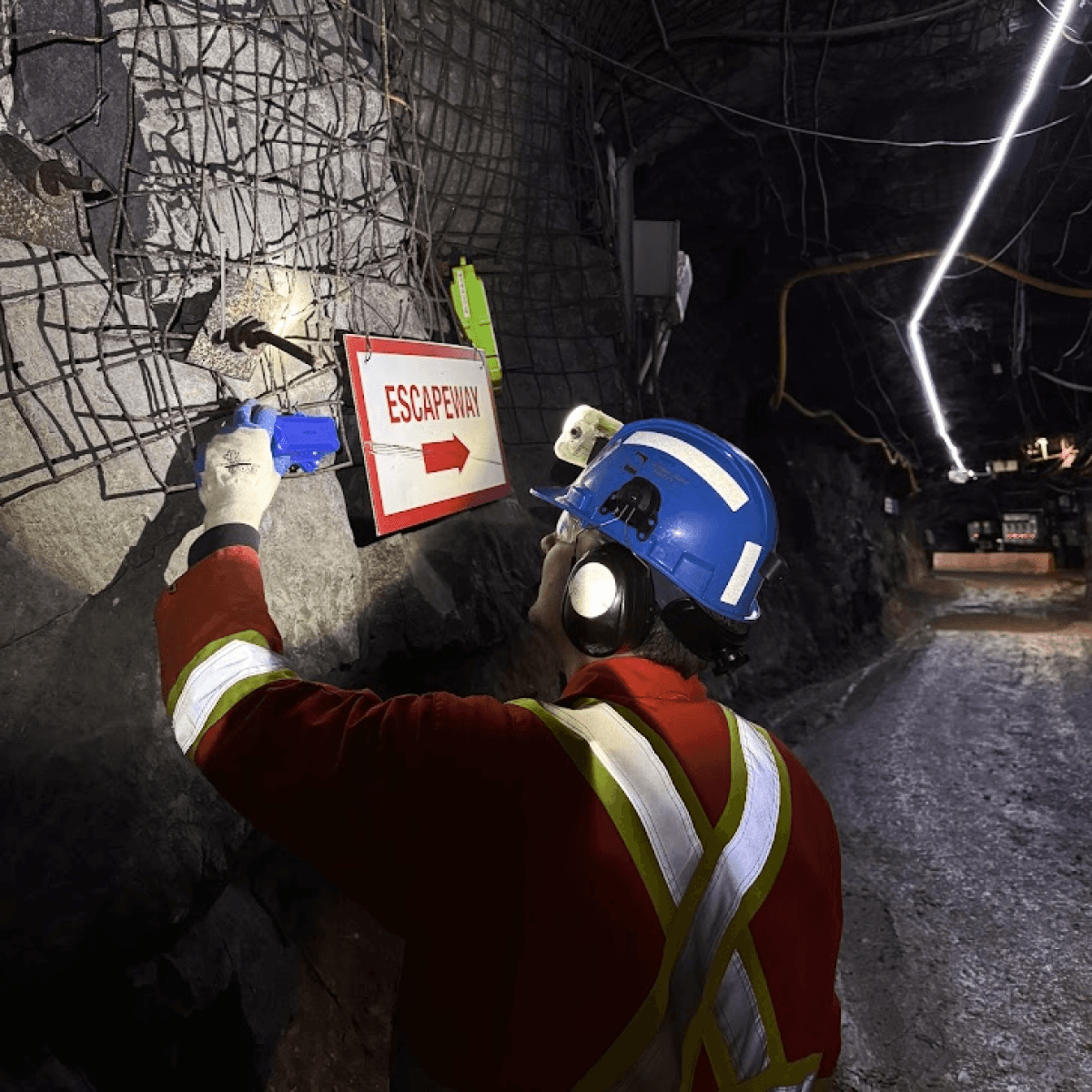
Anchor placement near a drift junction. Getting a spot with line of sight down two directions of tunnel, like this one, gets you the best routing.
The headline result: the entire test network went from empty drift to fully operational in 2.5 hours, with two installers. No electricians, no conduit, no waiting on permits for cable runs. That speed is the whole point of a battery-powered mesh, and NORCAT is where we proved it held up underground, not just in a warehouse.
The hardware
Three device types went into the ground at NORCAT, each doing a different job:

Dorado, the fixed mesh anchor. C1D2-rated and IP67-sealed, cable-tied to the drift wall or rock-bolted mesh screening, with a battery rated for up to 15 years. The Dorado is what forms the mesh backbone: every anchor talks to its neighbors and routes data back toward the gateway, so the network can scale to as many anchors as a site needs without any of them needing power run to them.

Pavo HD, the equipment tag. Also C1D2-rated and IP67-sealed, magnetically or adhesively-mounted directly to equipment (scoops, scissor decks, forklifts, personnel carriers at NORCAT). Pavo HD is a mesh device in its own right, and it provides location updates by measuring the signal strength of nearby anchors and transmitting those to the cloud through the Wirepas Mesh network.
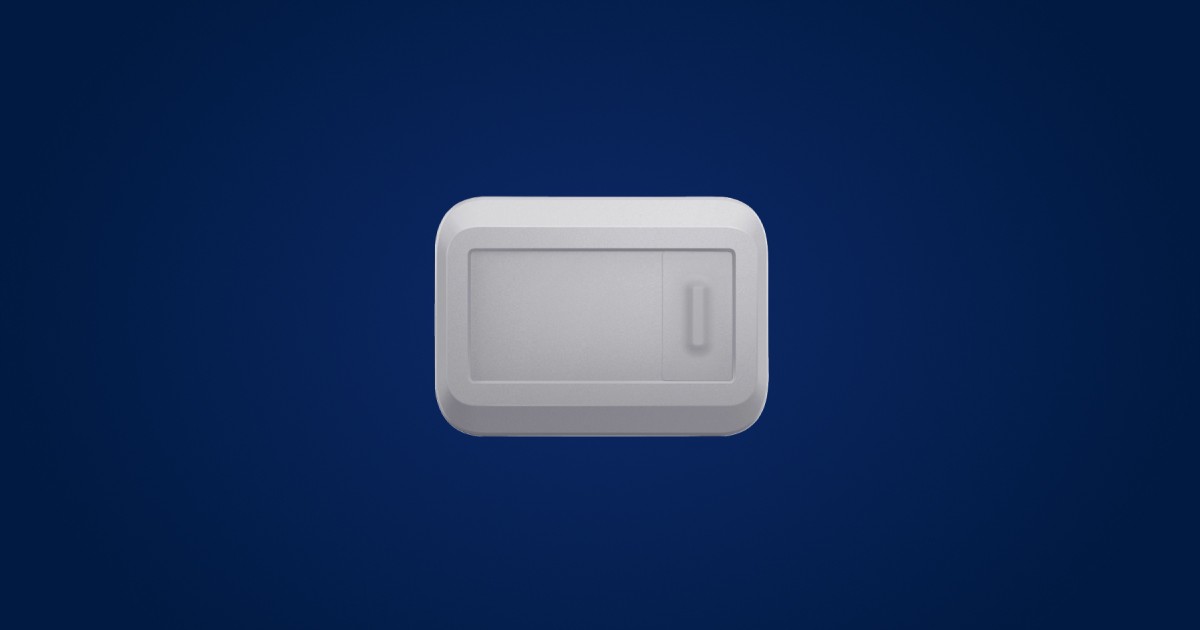
Mokosmart H7, the helmet tag. Built through Velavu's hardware partnership with Mokosmart, the H7 ships pre-loaded with Velavu firmware, so it runs as a native Wirepas Mesh tag. It clips onto a hard hat, is IP67-rated, and has a built-in SOS button and fall-detection accelerometer.
What we found (including the part that changed our pitch)
Range and configuration testing across multiple layouts converged on 80 feet as the optimal anchor spacing in a mine drift, meaningfully farther than the 40 to 50 feet we typically recommend indoors. Anchors performed best with a clear or near-clear line of sight to their neighbor, which is easier to arrange in a straight drift than in a warehouse full of racking. This longer range is likely a result of the surrounding rock acting as a signal reflector down the length of the drift, combined with the high-performance antenna in the Velavu Dorado anchor.
The less flattering finding was latency. Mine drifts form long, linear "chains" of anchors rather than the more web-like topology you get in an open indoor space, and every hop in a chain adds delay. We measured higher latency than expected as a direct result of that chain topology. It's a real limitation, and it's specific to how mines are physically laid out, not a flaw in the mesh protocol itself.
That finding mattered enough to change our pitch for the entire mining vertical. We had been considering personnel safety and emergency alerting as a use case, work that depends on near-instant notification. The latency we measured at NORCAT made clear that equipment and asset tracking, where a location update latency of 30 to 45 seconds is perfectly fine, was the better fit for a battery-powered mesh in a underground tunnel network. Despite that latency, the network is still useful for personnel in a mine: knowing where crews are working underground and maintaining a record for compliance purposes doesn't require sub-second updates, just a reliable one.
Over eight months of monitoring after the initial deployment, the network held up well: 100% uptime, with zero anchors going offline. A handful of position-accuracy issues showed up in specific blind spots in the mine, and we resolved those by adding anchors rather than redesigning anything. Neither the tags nor the anchors showed any sign of moisture damage despite the mine's damp conditions, which was a real test of the IP67 enclosure rating and not just a spec sheet claim.
Inside the dashboard
What the network actually looked like from the platform side is easier to show than describe.
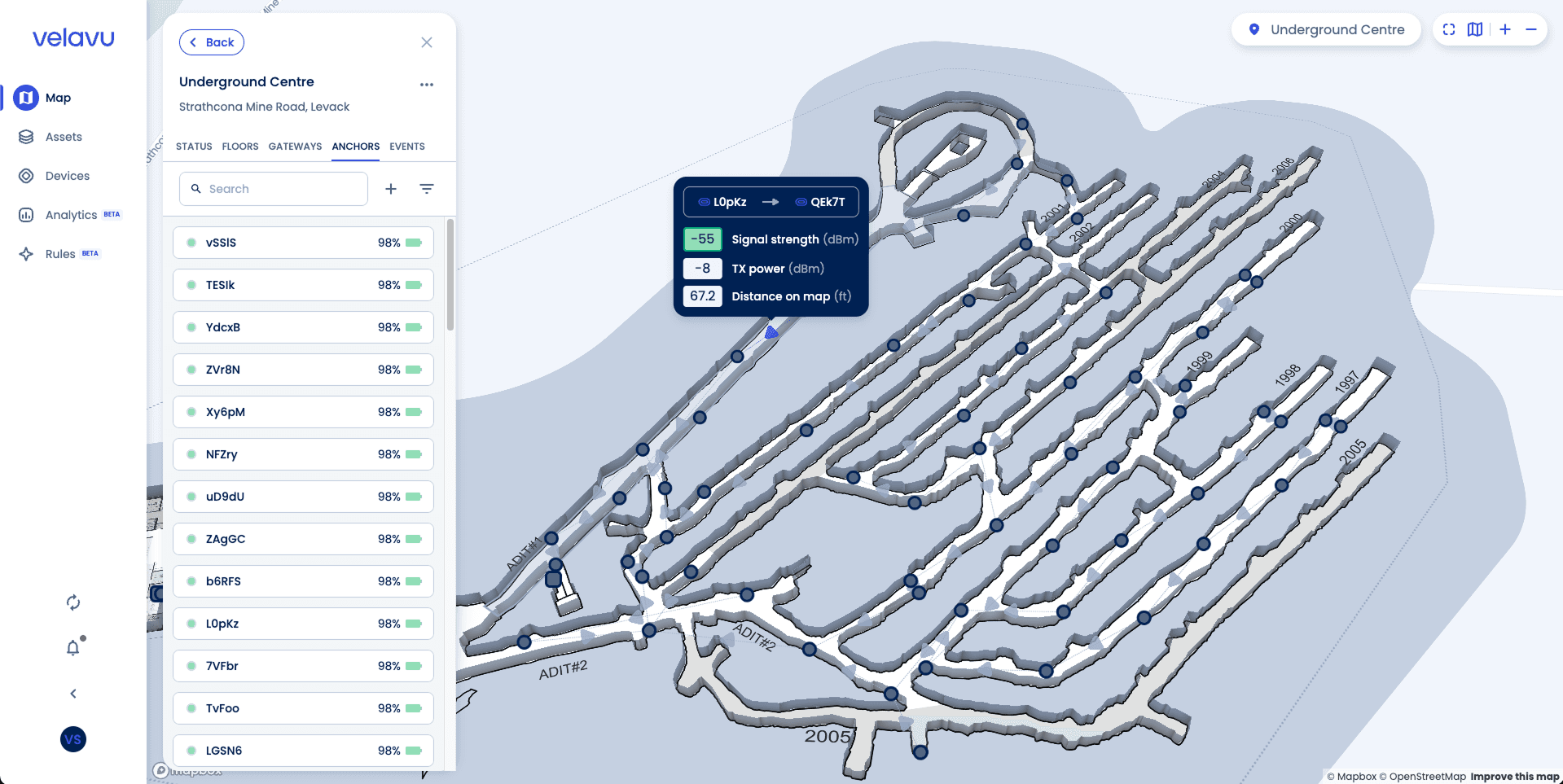
The anchor map at NORCAT, spanning multiple parallel drifts. Clicking any link between two anchors shows the live signal strength and distance, here, -55 dBm across 67 feet between two neighboring anchors, which is what the mesh uses to route around a dead node if one goes offline.
The site tracked various pieces of equipment during testing: scoops, scissor decks, forklifts, and personnel carriers, the same mix listed in the original test plan.
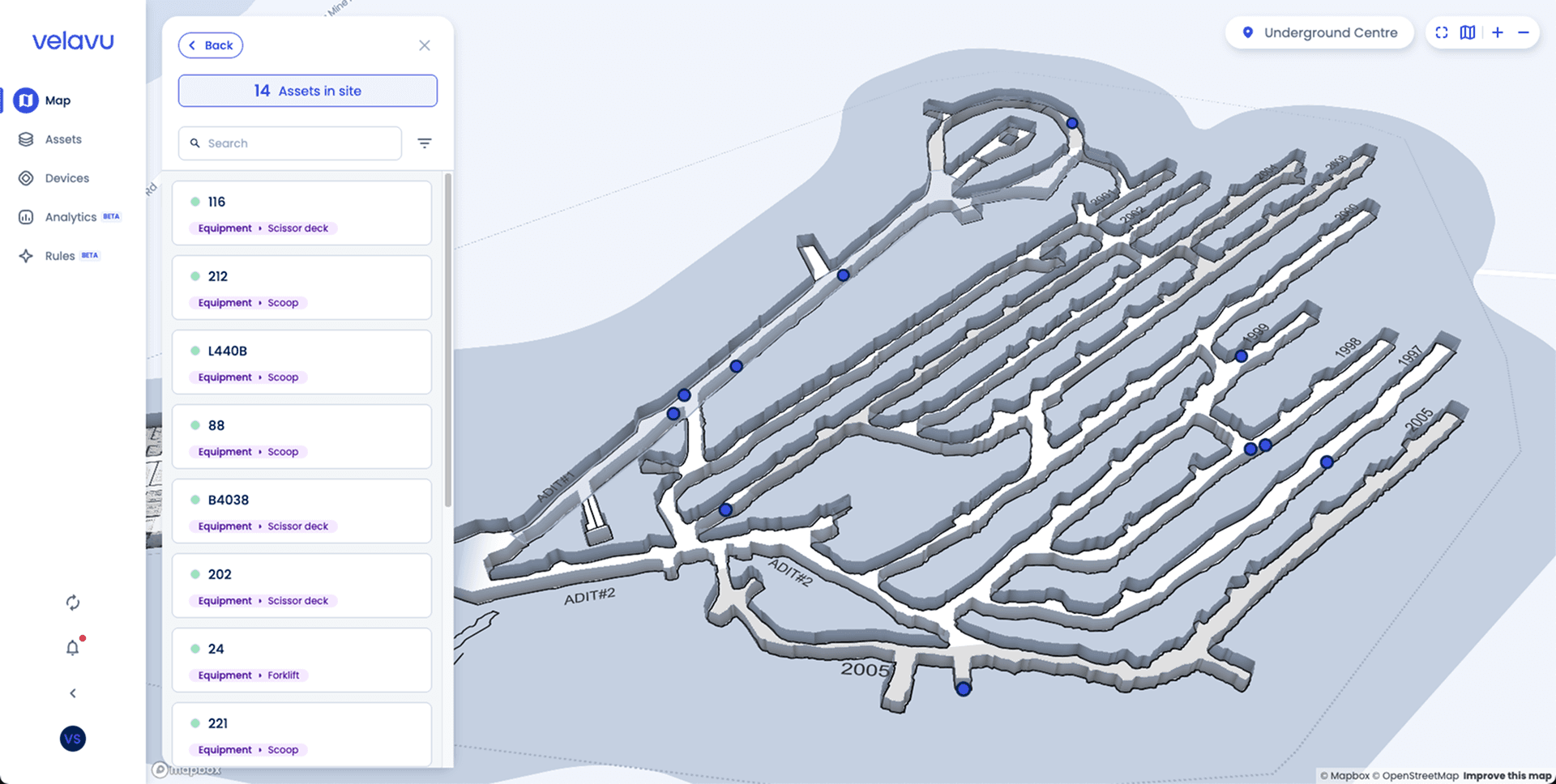
Assets tagged and visible on the map, tagged by type so a shift boss can filter down to just the equipment they're looking for.
Historical replay was one of the more useful features for NORCAT's own team: pick a date range, and the dashboard draws the actual path an asset took through the drifts.
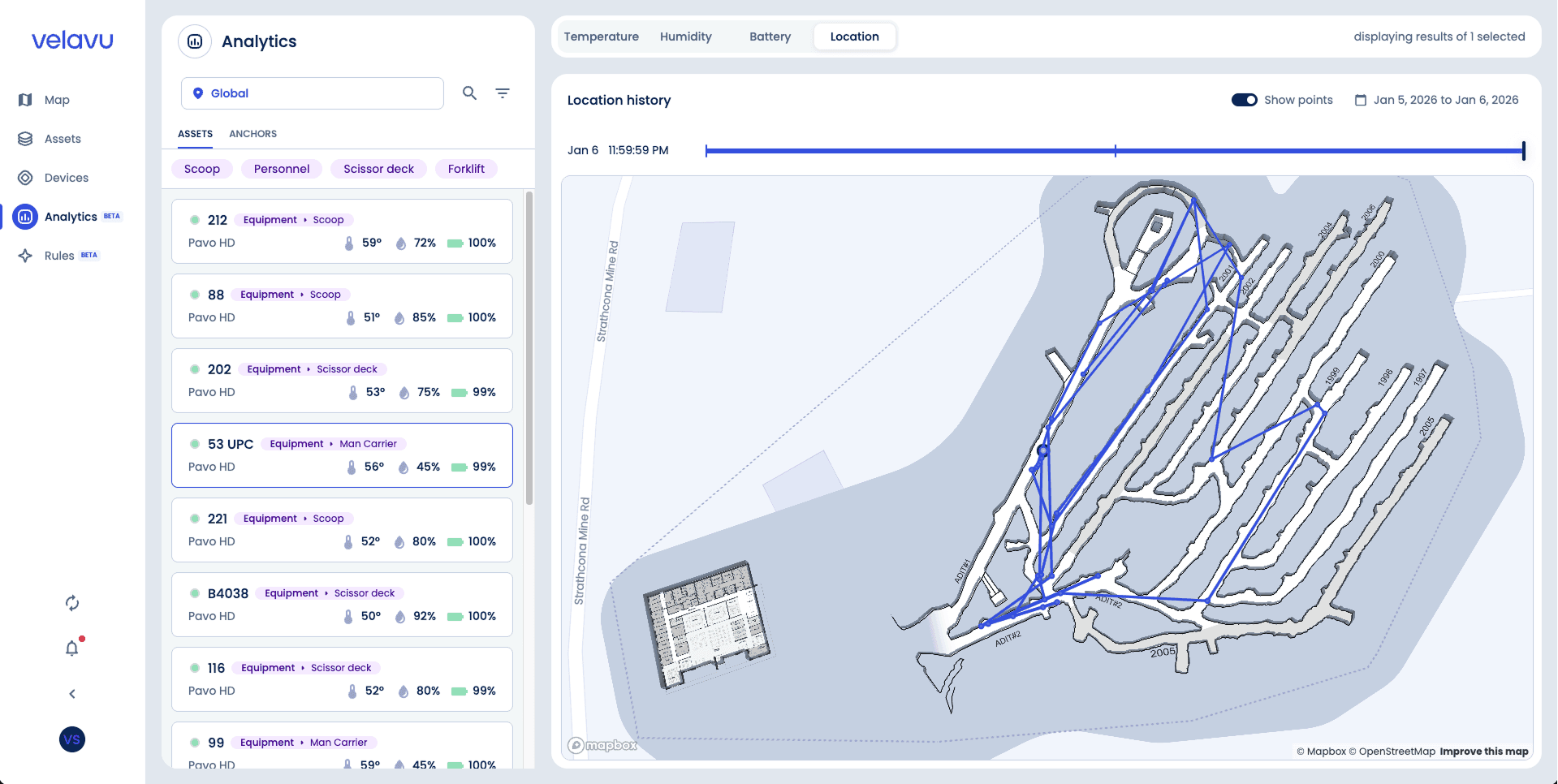
Location history for a scoop over a 24-hour window, replayed against the mine's floor plan.
The result
By the end of the project, NORCAT personnel had hands-on access to the Velavu platform and could pair devices, monitor assets, and pull historical location data themselves, and we received praise from operators for how easy the Velavu web and mobile apps were to use. That mattered as much as the technical results. A system that only the vendor knows how to operate isn't one a mine is going to adopt.
The total hardware cost for a small mine deployment like NORCAT's came in at a fraction of the cost of other asset tracking systems on the market, deployed by two people in an afternoon. That's the advantage we lead with in mining conversations now, and it's a direct result of what we validated here: a battery-powered, fully routed mesh network doesn't need the mine to change anything about its existing infrastructure to get real-time visibility into where equipment is.
NORCAT was Velavu's first deployment in an underground mine, and it's become the reference we point to whenever a mining prospect asks whether wireless asset tracking can actually work underground, backed by eight months of real operating data rather than a lab estimate. The lessons on anchor spacing and routing optimizations carried straight into later work, including an active deployment at a mine in the United States tracking haul-truck cycle times. Velavu now has hands-on experience deploying and operating Wirepas Mesh networks underground, and we're excited to see where we go next.
Interested in what a Wirepas Mesh deployment would look like at your site or underground mine? Get in touch below or read more about how Wirepas Mesh networking works.